
A new lead fills out your website form at 7:40 p.m. They also filled out two of your competitors’ forms. The first business to reply with a real answer and an easy way to book usually gets the job. The other two are left calling someone who has already moved on.
That’s speed to lead in a nutshell. This guide covers what it means, what research says about lead response time, how to measure yours, and how automated appointment booking and an omnichannel inbox let a small business respond in seconds, even when everyone is busy.
Want it done for you? We set up automated appointment booking and an omni-channel AI responder that replies to every new lead instantly and books them on your calendar.
What Is Speed to Lead?
Speed to lead is the time between a potential customer reaching out, by form, call, text or message, and your business giving them a real, useful response. The shorter that gap, the more likely you are to have a conversation and book the job.
It’s not the same as an auto-reply that says “we got your message.” A real response answers the question, asks what you need to know, or offers a time to book.
What Does Research Say About Lead Response Time?
The most-cited research on lead response time comes from a study published in Harvard Business Review in 2011, “The Short Life of Online Sales Leads” (HBR). The authors found two things worth knowing:
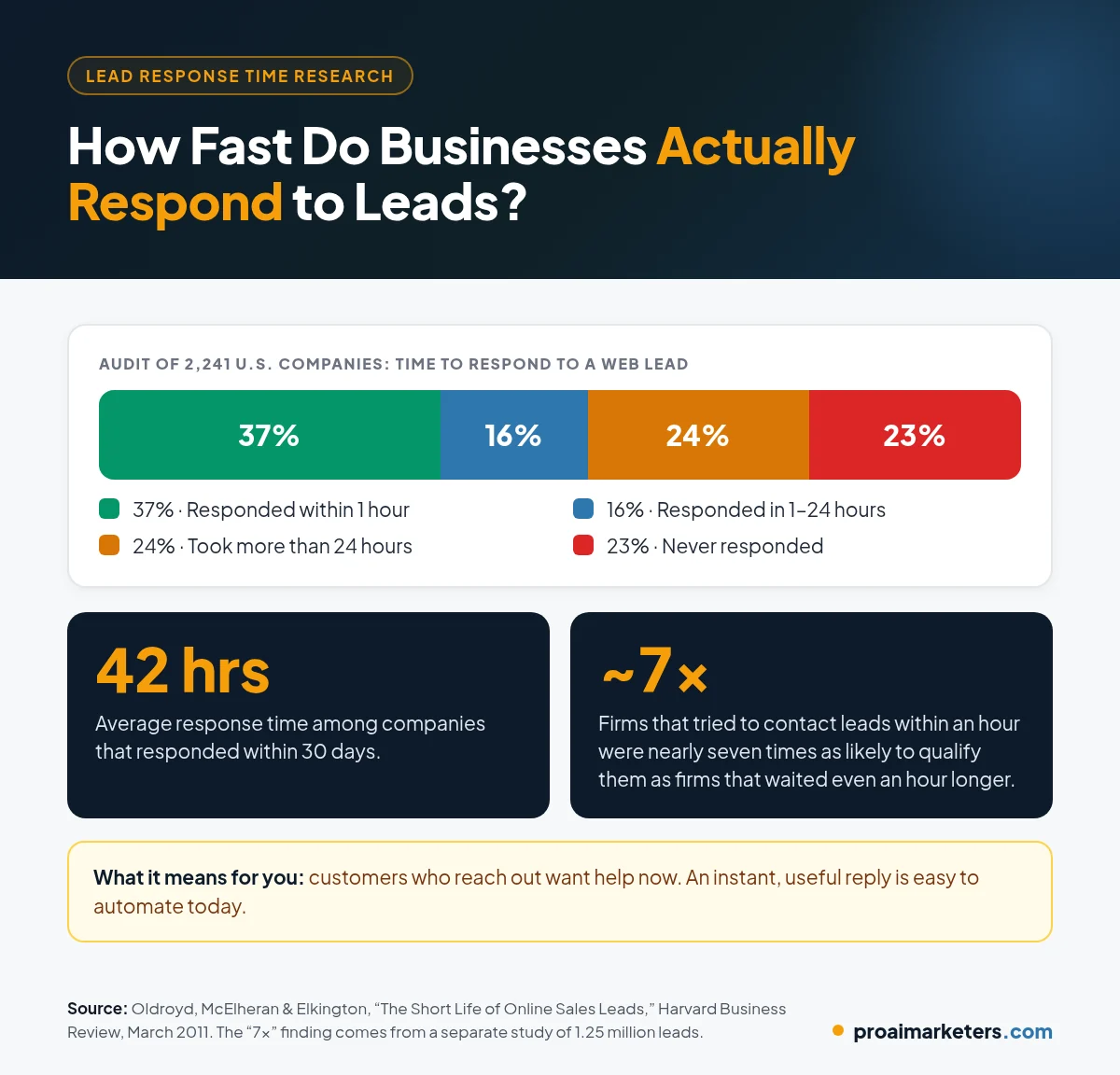
- Most companies were slow. In an audit of 2,241 U.S. companies, 37% responded to a web lead within an hour, 16% took one to 24 hours, 24% took more than 24 hours, and 23% never responded at all. The average response time, among companies that responded within 30 days, was 42 hours.
- Speed made a big difference. In a separate study of 1.25 million sales leads, firms that tried to contact leads within an hour were nearly seven times as likely to qualify the lead as those that waited even an hour longer, and more than 60 times as likely as companies that waited 24 hours or longer.
That research is more than a decade old and looked at online leads across many industries, so treat it as direction rather than a promise. But the lesson matches what most service business owners see: people who reach out want help now, and many contact more than one business.
Why Do Service Businesses Lose Leads to Slow Response?
It’s rarely because anyone doesn’t care. It’s usually because:
- You’re working. Owners and crews are on jobs or with clients during the hours most leads come in.
- Leads arrive after hours. Evenings and weekends are when many customers finally have time to research.
- Leads are scattered. Calls, texts, web forms, Facebook and Instagram messages, and email all land in different places.
- Handoffs are manual. Someone has to notice the lead, copy it somewhere, and remember to call back.
- Voicemail stops the conversation. Many callers won’t leave a message, so you can’t call them back.
How Do You Measure Your Own Lead Response Time?
Before you fix anything, find out where you stand. It takes about an hour:
- Send test leads through every channel: your web form, a phone call you don’t answer, a text, and a message on each social platform you use.
- Note the time you sent each one and the time a real response came back.
- Check your CRM for recent leads and compare when each one arrived with when someone first replied.
- Track three numbers each month: time to first response, time to booked appointment, and the share of leads that booked.
Use your own numbers as the benchmark. The goal is to get faster than you are today and faster than the competitors your customers are also contacting.
How Does Automated Appointment Booking Improve Speed to Lead?
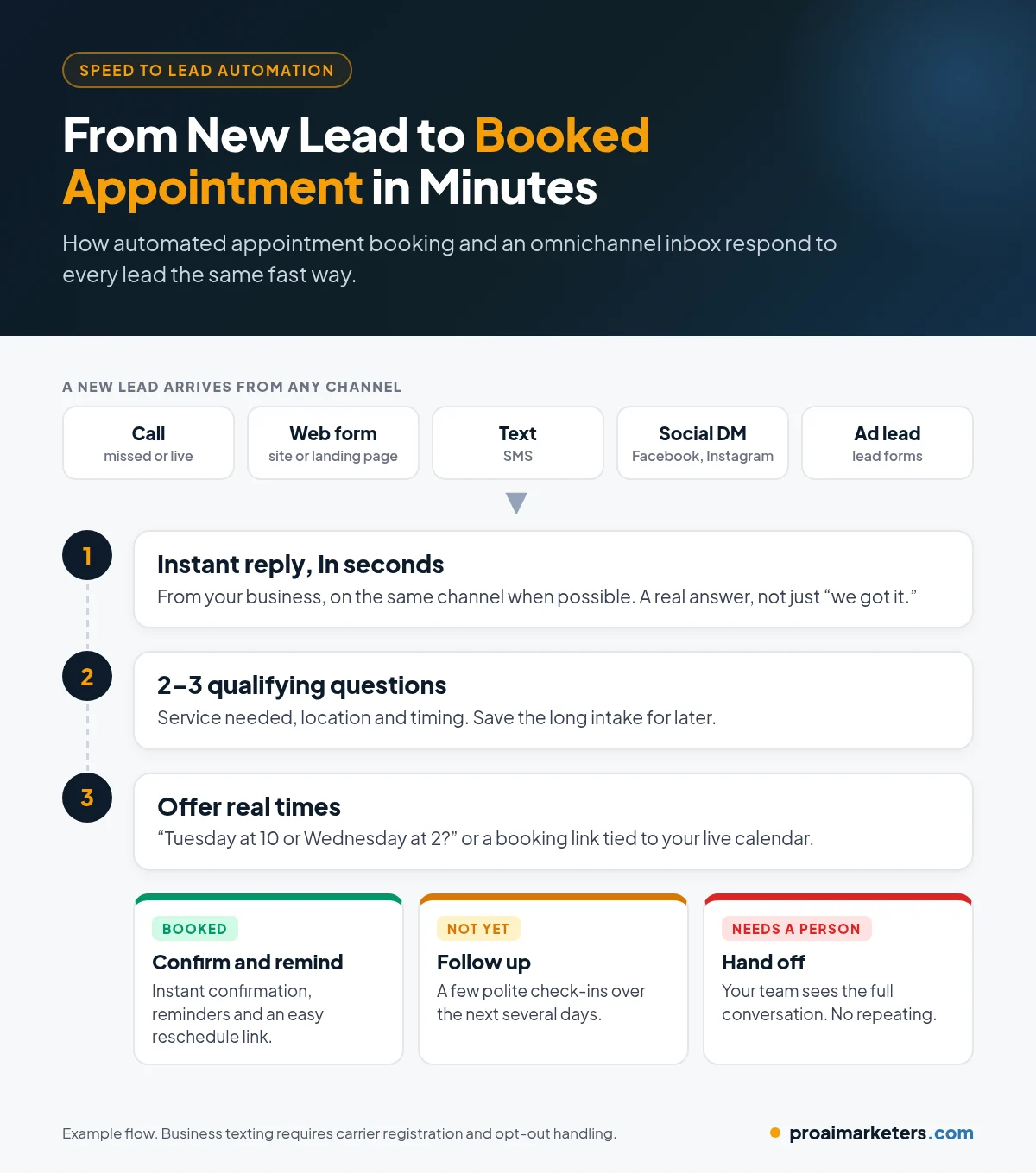
Automated appointment booking removes the waiting between “I’m interested” and “you’re on the calendar.” Here’s the typical flow:
- A lead comes in from any channel: a call, form, text, social message or ad.
- An instant reply goes out within seconds, from your business, on the same channel when possible.
- The AI or automation asks two or three questions, such as the service needed, the location and the timing.
- It offers real times from your calendar, or sends a booking link.
- The appointment is booked, and the customer gets a confirmation plus reminders before the visit.
- If they don’t book, a short follow-up sequence checks in over the next few days.
- A person takes over whenever the lead asks for one, or the request is urgent or complex.
Why Does an Omnichannel Inbox Matter for a Small Business?
Speed to lead falls apart when leads are spread across five apps. An omnichannel inbox for small business pulls calls, texts, web chat, form fills, email and social messages into one place, so nothing gets missed and anyone on your team can reply.
It also lets one automation handle every channel the same way. The same instant reply, the same qualifying questions and the same booking link work whether the lead came from Instagram or your contact form.
One change worth knowing: Google discontinued chat on Google Business Profile as of July 31, 2024 (Google Business Profile Help). If customers used to message you there, make sure your profile points them to a phone number and website chat or booking option that feeds your inbox.
What Should the Instant Response Look Like on Each Channel?
| Channel | Instant response | Next step |
|---|---|---|
| Missed phone call | Automatic text from your business number | Ask what they need, offer a booking link |
| Web form | Text and email within seconds | Confirm the request, offer times |
| Website chat | AI chat reply | Answer questions, book in the chat |
| Facebook or Instagram message | AI reply in the same thread | Qualify and send a booking link |
| Ad lead form | Text and email right away | Qualify, book, or hand off to a person |
For missed calls specifically, our missed call text back guide explains how the automatic text works and what to say.
What Are the Best Practices for Automated Booking?
- Use real availability. Connect the calendar your team actually works from, and add buffer time for travel.
- Offer a few specific times. “Tuesday at 10 or Wednesday at 2?” is easier than an open-ended question.
- Confirm and remind. Send a confirmation right away and reminders before the appointment, with an easy reschedule link.
- Ask only what you need. Save the long intake for the appointment itself.
- Respect the rules. Business texting needs carrier registration and a clear opt-out, and marketing texts and automated calls have consent requirements. Check your setup with your provider and, for marketing campaigns, an attorney.
When Should a Human Take Over?
Automation should handle the speed. People should handle judgment. Set clear handoff rules for:
- Emergencies and same-day urgent requests
- Complex quotes or custom projects
- Unhappy existing customers
- Anyone who asks for a person
When a handoff happens, the person should see the full conversation and the lead’s answers, so the customer never has to repeat themselves.
What Mistakes Hurt Speed to Lead?
- Fast but empty replies. “Thanks, we’ll be in touch” isn’t a response. Ask a question or offer a time.
- Broken booking links. Test your own booking flow on a phone every month.
- Wrong time zones or double bookings. Double-check calendar settings before you go live.
- No follow-up. Many leads don’t book on the first message. A few polite check-ins help.
- Ignoring old leads. Leads that never booked can be re-contacted later with a database reactivation campaign.
How Does Speed to Lead Fit With the Rest of Your Systems?
Fast response is most valuable when you’re already paying for leads, so it pairs naturally with paid advertising. An AI receptionist handles live calls the same way automation handles messages, and a CRM keeps every lead, conversation and appointment in one place.
Related guides: AI receptionist lead qualification and local SEO for service businesses.
Frequently Asked Questions
What is speed to lead?
Speed to lead is the time between a potential customer contacting your business and receiving a real, useful response. The shorter that time, the more likely you are to start a conversation and book the job.
What is a good lead response time?
Faster is better, and an instant automated reply is now easy to set up. A Harvard Business Review study found firms that tried to contact leads within an hour were nearly seven times as likely to qualify them as firms that waited an hour longer.
How does automated appointment booking work?
When a lead comes in, the system replies instantly, asks a few qualifying questions, offers open times from your calendar or sends a booking link, and then sends a confirmation and reminders once the appointment is booked.
What is an omnichannel inbox for small business?
An omnichannel inbox collects calls, texts, web chat, form fills, email and social messages in one place, so your team and your automations can reply to every lead quickly from a single screen.
Will automation make my business sound robotic?
It doesn’t have to. Write messages the way your best team member talks, keep them short, and set clear rules for when a real person takes over the conversation.
Be the First Business That Answers
Most customers don’t pick the biggest business. They pick the one that answers first and makes booking easy. Speed to lead automation makes sure that’s you, every time.
At Pro AI Marketers, we set up instant lead response, omnichannel inboxes and automated appointment booking for local service businesses across the U.S.
Book a free strategy call. We’ll test your current lead response time and show you where leads are waiting.