
If you run a service business, you know the moment. You’re on a roof, under a sink, halfway through a client appointment, or driving between jobs. The phone rings and you can’t pick up.
Most of those callers won’t leave a voicemail. They hang up, go back to Google, and call the next business on the list. You never even find out what the job was.
Missed call text back fixes this. When you can’t answer, the caller gets a friendly text from your business number within seconds. The conversation stays open, and you keep the lead even when your hands are full.
This guide covers what missed call text back is, why missed calls quietly cost you jobs, what to text (with examples for contractors and other local service businesses), and how to set it up the right way.
Want it done for you? See how our missed call text back service works, connected to your CRM, calendar and review requests.
What Is Missed Call Text Back?
Missed call text back is an automation that sends a text message to anyone whose call to your business goes unanswered. It usually goes out within a few seconds of the missed call, from the same number they dialed.
A simple version looks like this:
“Hi, this is Maria with [Business Name]. Sorry I missed your call, I’m with a customer right now. How can I help? You can reply here or book a time: [booking link]”
The caller can reply by text, which many people prefer anyway. You, your team or an AI assistant pick up the conversation from there.
How it’s different from an AI receptionist
Missed call text back is the starting point. It catches the lead and starts a text conversation. An AI receptionist goes further: it answers the call live, asks qualifying questions, and books the appointment. Many businesses start with text back and add an AI receptionist once they see how many calls they were missing.
Lost Leads From Missed Calls: Why This Matters for Small Businesses
Missed calls are easy to ignore because you never see what they cost. There’s no invoice for the job you didn’t get. But a few patterns are common across almost every local service business:
- Callers usually have an urgent need. Someone with a leaking water heater, a lockout, or a last-minute appointment isn’t browsing. They want help now, and they’ll keep calling until someone responds.
- Your competitors are one tap away. On “near me” searches, the map results put several businesses side by side. The one that responds first often gets the job.
- You’re busiest when calls come in. Owner-operators and small crews are on site during the same hours customers call. Peak demand and peak “can’t answer” time overlap.
- Calls come in after hours. Plenty of customers work during your business hours and call in the evening or on weekends.
- Voicemail isn’t a safety net. Many people simply don’t leave messages, so you can’t call them back.
Estimate what missed calls cost you
You don’t need industry benchmarks. Your own numbers are more useful. Pull your call log for the last 30 days and fill in this simple formula:
Missed calls per month × share of callers who would normally book × average job value = revenue at risk each month
Use your real close rate and average ticket. Even a conservative estimate usually makes the case for a fast, automatic follow-up.
Missed Call Recovery for Small Business: How It Works, Step by Step
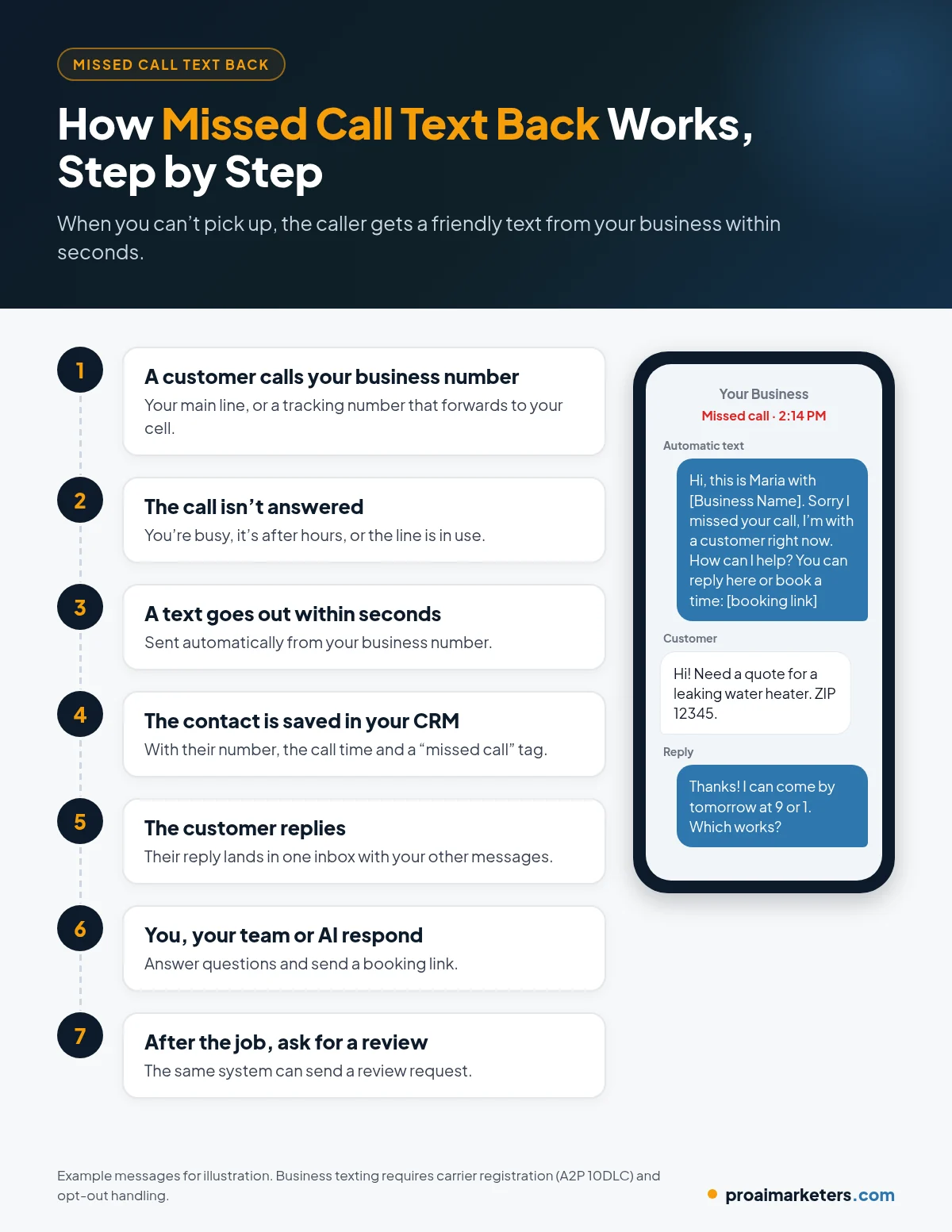
“Missed call recovery” just means having a system that reaches back out to every caller you couldn’t answer. Here’s the typical flow inside a CRM:
- A customer calls your business number. This can be your main line or a tracking number that forwards to your cell.
- The call isn’t answered. You’re busy, it’s after hours, or the line is in use.
- The system detects the missed call and sends a text from your business number within seconds.
- The contact is saved automatically in your CRM with their phone number, the time they called, and a tag like “missed call.”
- The customer replies. Their reply lands in one inbox, alongside your Facebook, Instagram, Google and website chat messages if you use an omni-channel inbox.
- You, your team or an AI assistant respond, answer questions and send a booking link or schedule the visit.
- After the job, the same system can send a review request, which helps your Google Business Profile.
Missed Call Text Back for Contractors
Contractors are a natural fit for missed call text back because the work itself makes answering the phone hard. You can’t take a call mid-install, on a ladder, or in a crawl space, and many jobs come from homeowners with a problem that can’t wait.
A good contractor setup usually includes:
- A first text that asks for the details you need to quote or dispatch, such as the service needed, the address or ZIP code, and how urgent it is.
- An option to send photos. For many trades, a photo of the problem tells you more than a five-minute phone call.
- Separate after-hours messages so emergency callers know what to expect and when you’ll respond.
- Routing to the right person. If you have an office manager or dispatcher, replies should go to them first, not just to the owner’s phone.
What to Text: Examples by Industry
Keep the first message short, human and useful. Use your name, say why you missed the call, and give one clear next step. These are examples to adapt, not scripts you have to copy word for word.
HVAC, plumbing and electrical contractors
“Hi, this is [Name] with [Business]. Sorry I missed your call, I’m on a job. What’s going on? Reply with the issue and your ZIP code (photos help) and I’ll get back to you shortly.”
Roofing, remodeling and other estimate-based trades
“Thanks for calling [Business]! Sorry I couldn’t pick up. Are you looking for an estimate or a repair? Reply with your address and a quick description, or grab an estimate time here: [link]”
Locksmiths and other emergency services
“Hey, it’s [Business]. Sorry I missed your call, I’m with another customer. Are you locked out right now? Reply with your location and what you’re locked out of (car, home, business) and I’ll respond right away.”
House cleaning and short-term rental turnover
“Hi! This is [Name] with [Business]. Sorry I missed your call. Is this for a regular clean, a move-out, or a rental turnover? Reply with your ZIP code and the date you need, or book here: [link]”
Salons, med spas, brow and lash studios
“Hi, it’s [Name] from [Studio]. I’m with a client, sorry I missed you! Are you asking about a new appointment, a touch-up, or pricing? You can book a consultation here: [link]”
Mobile notaries and other appointment-based services
“Hi, this is [Name] with [Business]. Sorry I missed you, I’m at an appointment. Reply with what you need, your location and when you need it, and I’ll confirm availability.”
Tip: Only promise what you can deliver. After hours, say when you’ll reply instead of implying you’re available right now.
How to Set Up Missed Call Text Back the Right Way
The setup decides whether it helps or annoys people. Here’s our checklist.
1. Use a real business number that can send texts
Texts should come from the number the customer called. Most CRMs can give you a local number in your area code or connect your existing one.
2. Register for business texting (A2P 10DLC)
In the U.S., texts sent from software through a standard 10-digit local number need to be registered with the carriers under what’s called A2P 10DLC. Unregistered messages are more likely to be filtered or blocked. Your platform or agency should handle the registration, which includes your business details and sample messages.
3. Write separate business-hours and after-hours messages
During the day: “I’m with a customer, I’ll text you back shortly.” After hours: “We’re closed, but reply with what you need and we’ll reach out in the morning.”
4. Connect it to your calendar
A booking link in the first text lets customers who are ready book a time on their own, even when you’re unavailable.
5. Route replies somewhere you’ll actually see
Replies should trigger a push notification on your phone or go to a team inbox someone actually checks.
6. Include opt-out language and respect it
Make it easy for people to stop messages (for example, “Reply STOP to opt out”) and make sure your system honors it automatically. Rules about business texting and consent change, so check your setup with your provider. If you send any marketing messages beyond answering the person who called you, get advice on consent requirements.
7. Track the results
Each month, check three numbers: missed calls, replies to the text, and bookings. Use your own numbers, not someone else’s benchmarks.
Common Mistakes to Avoid
- Sounding like a robot. “Your call is important to us” doesn’t start a conversation. Write like a person.
- Asking too many questions in the first text. One question or one link is enough.
- Never following up. One gentle follow-up later can bring back people who meant to reply and forgot.
- Letting replies sit. A text back only helps if someone answers the reply quickly.
- Using it instead of answering. Text back catches calls you can’t take. It doesn’t replace good phone habits.
When to Add an AI Receptionist
Missed call text back is a good first step. Consider adding an AI receptionist if:
- You miss a lot of calls during peak hours.
- Your customers expect a live answer (emergency repair or lockout calls, for example).
- You want calls qualified and booked without picking up the phone.
Over time, missed-call contacts who never booked build up in your CRM. A database reactivation campaign can reach back out to those past leads. Our guide to what database reactivation is and how it works explains the process.
Related guides: speed to lead and automated booking and AI receptionist lead qualification.
Frequently Asked Questions
What is missed call text back?
Missed call text back is an automation that sends a text from your business number to anyone whose call you don’t answer, usually within seconds. It invites them to reply by text or book online so you don’t lose the lead.
Does missed call text back work with my existing business number?
Often, yes. Many platforms can connect your existing number or forward calls through a new local number. The right option depends on your phone carrier and setup, so check before you switch anything.
Is missed call text back worth it for contractors?
For most contractors it’s a good fit, because you often can’t answer while you’re on a job and many callers need help quickly. A fast text keeps the conversation going until you can respond, and it can collect details like the address and photos before you call back.
Is it legal to text people who called my business?
Replying by text to someone who just called you is a common practice, but business texting has rules, including carrier registration (A2P 10DLC) and honoring opt-out requests. Rules can change, so check with your provider, and get legal advice before sending marketing texts.
How is missed call text back different from an AI receptionist?
Missed call text back sends an automatic text after a missed call. An AI receptionist answers the call itself, holds a conversation, and can book appointments. Many businesses use both.
Stop Losing Leads to Voicemail
Every missed call is someone who wanted to hire you. Missed call text back makes sure they hear from you first, even when you’re busy with a customer.
At Pro AI Marketers, we set up missed call text back for local service businesses across the U.S., connected to your CRM, calendar and review requests, so it works from day one. You can see everything we offer on our services page.
Book a free strategy call. We’ll look at how calls come into your business today and show you where leads are slipping through.