
Referrals are wonderful until they slow down. Paid ads work until costs rise. Many service business owners then ask a fair question: can we start conversations with people who have never heard of us, without sounding spammy?
Yes, if you treat cold outreach for service businesses as a system: a clear ideal customer, a clean prospect list, personalized multi-channel messages, fast reply handling and a calendar link ready when someone says yes. This guide walks through that system step by step.
Want it done for you? Our cold outreach service builds prospect lists and runs personalized LinkedIn and email sequences that aim to book meetings, not blast strangers.
What Counts as Cold Outreach (and What Does Not)
Cold outreach means contacting someone who has not asked you to contact them yet, with a relevant reason they might care. Typical channels for service and B2B service businesses:
- LinkedIn connection requests and follow-up messages
- Cold email to a business or decision-maker address
- Sometimes a warm phone call after an email or LinkedIn touch
It is not:
- Texting random consumer cell numbers you bought in a list (high legal and reputation risk)
- Mass identical DMs to everyone who follows a local hashtag
- Scraping personal emails and blasting a sales pitch with no opt-out
Inbound channels (people who called, form-filled or messaged you) belong in your omnichannel AI inbox and speed-to-lead setup. Cold outreach is the opposite direction: you start the conversation.
When Cold Outreach Makes Sense for a Service Business
Cold outreach fits best when:
- You sell to other businesses (B2B): bookkeeping, commercial cleaning, IT, marketing, staffing, facilities, B2B notary or mobile services for offices.
- Your average job or contract value is high enough that a few meetings per month matter.
- You can describe an ideal customer in plain language (industry, size, location, role).
- Someone on your team can take discovery calls when replies come in.
It is a weaker first move when:
- You only sell low-ticket one-off jobs to random homeowners and have no niche.
- You cannot handle replies within a business day.
- You hoped outreach would replace a broken website, missing Google profile or slow lead response. Fix those first with local SEO, an omni-channel AI responder for inbound messages, and fast follow-up.
Many owners run cold outreach alongside paid advertising, not instead of it. Ads capture demand that already exists. Outreach creates conversations where demand is quieter.
Step 1: Define Who You Are Allowed to Contact
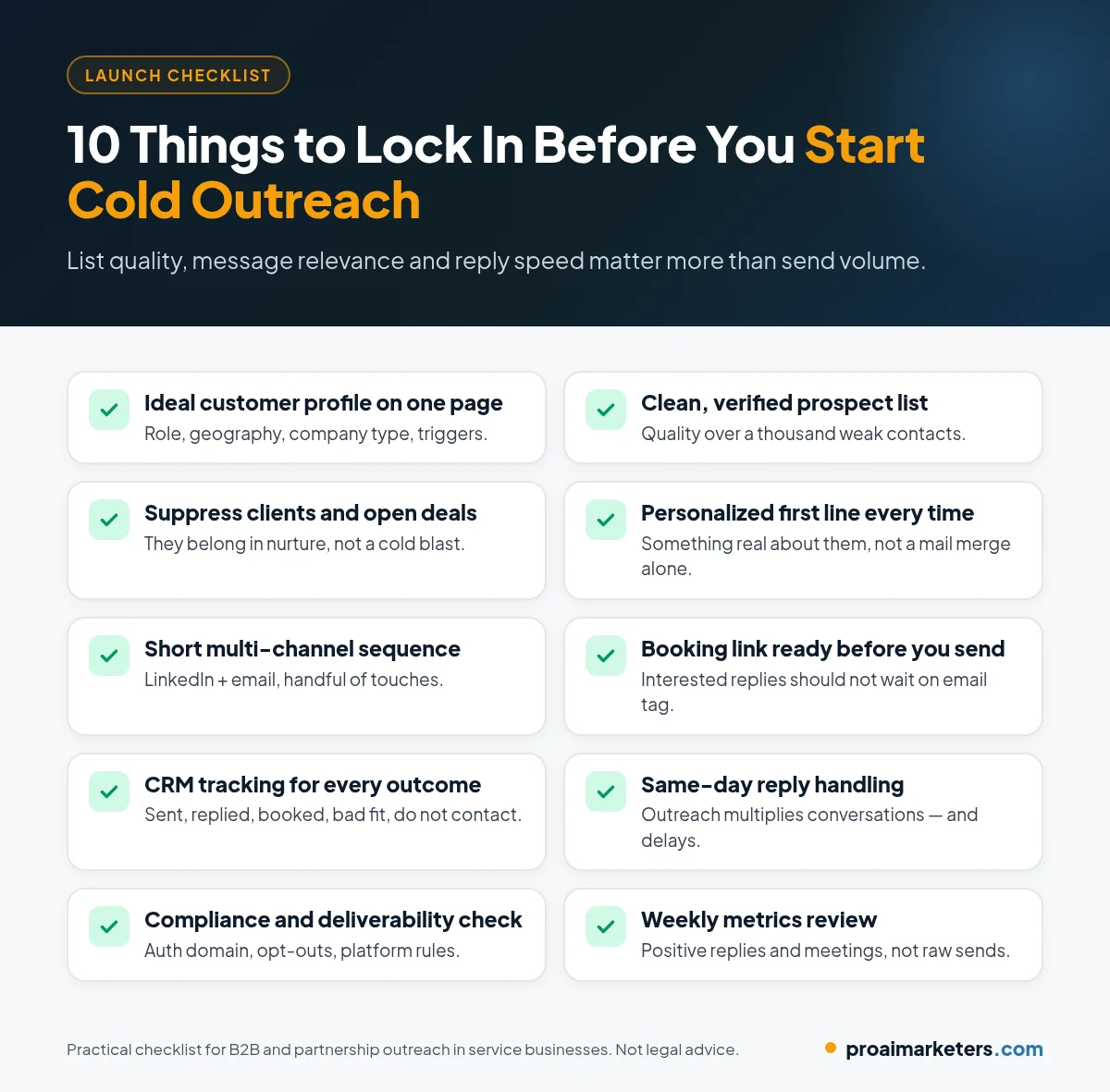
Write a one-page ideal customer profile before you build any list:
- Who: title or role (office manager, owner, property manager)
- Where: geography you can actually serve
- What company type: industry, approximate size, or property type
- Why now: a trigger you can notice (new location, hiring, seasonal need, compliance deadline)
- What you will not chase: bad-fit niches that drain sales time
If two partners cannot agree on that page, your messages will sound generic because the offer is still fuzzy.
Step 2: Build a Clean Prospect List
Quality beats a huge spreadsheet.
- Source intentionally. LinkedIn search, local business directories, chamber lists, your own past quote list (with permission rules in mind), or a researched list from a partner.
- Verify contact details. Bad emails hurt deliverability. Incomplete LinkedIn profiles waste connection requests.
- Deduplicate. One person should not get three parallel sequences from you.
- Suppress people who already know you. Current clients, open opportunities and recent inbound leads belong in CRM nurture or database reactivation, not a cold sequence.
- Start small. A few dozen highly relevant contacts teach you faster than a thousand weak ones.
Load the accepted list into your CRM so every send, reply and meeting is tracked.
Step 3: Write Messages People Might Actually Answer
Cold outreach fails when every line is about you. Lead with them.
Core rules
- Personalize with something real. Company name, role, a public post, a location or a relevant problem, not “{{first_name}}” alone.
- One clear reason for the note. Why them, why you, why now.
- Ask for a small next step. A 15-minute call or a yes/no question beats a long brochure.
- Keep it short. A few sentences on LinkedIn. A short email with a subject line that does not scream “sales.”
- Sound like a person. No fake urgency, no “I help companies like yours 10x revenue” fluff.
Example structure (adapt to your niche)
- Line 1: Why you noticed them (specific).
- Line 2: The problem you solve, in their language.
- Line 3: Soft proof without fabricated metrics (type of client or situation you serve).
- Line 4: Simple ask (“Open to a quick call next week?”).
Do not invent case-study numbers or testimonials in outreach copy. If you do not have a documented result to share, describe the type of work you do instead.
Step 4: Run a Multi-Channel Sequence (Not One Lonely Email)
One touch is easy to miss. A short, respectful sequence works better:
- Day 1 — LinkedIn connection request with a short note (or a plain request if notes are limited).
- Day 3 — LinkedIn message after they accept, with the real value and ask.
- Day 5 — Email that continues the same thread of ideas (do not copy-paste the LinkedIn message word for word).
- Day 8 — Short follow-up email with a booking link for people who want an easy yes.
- Day 14 — Breakup note that leaves the door open and stops the chase.
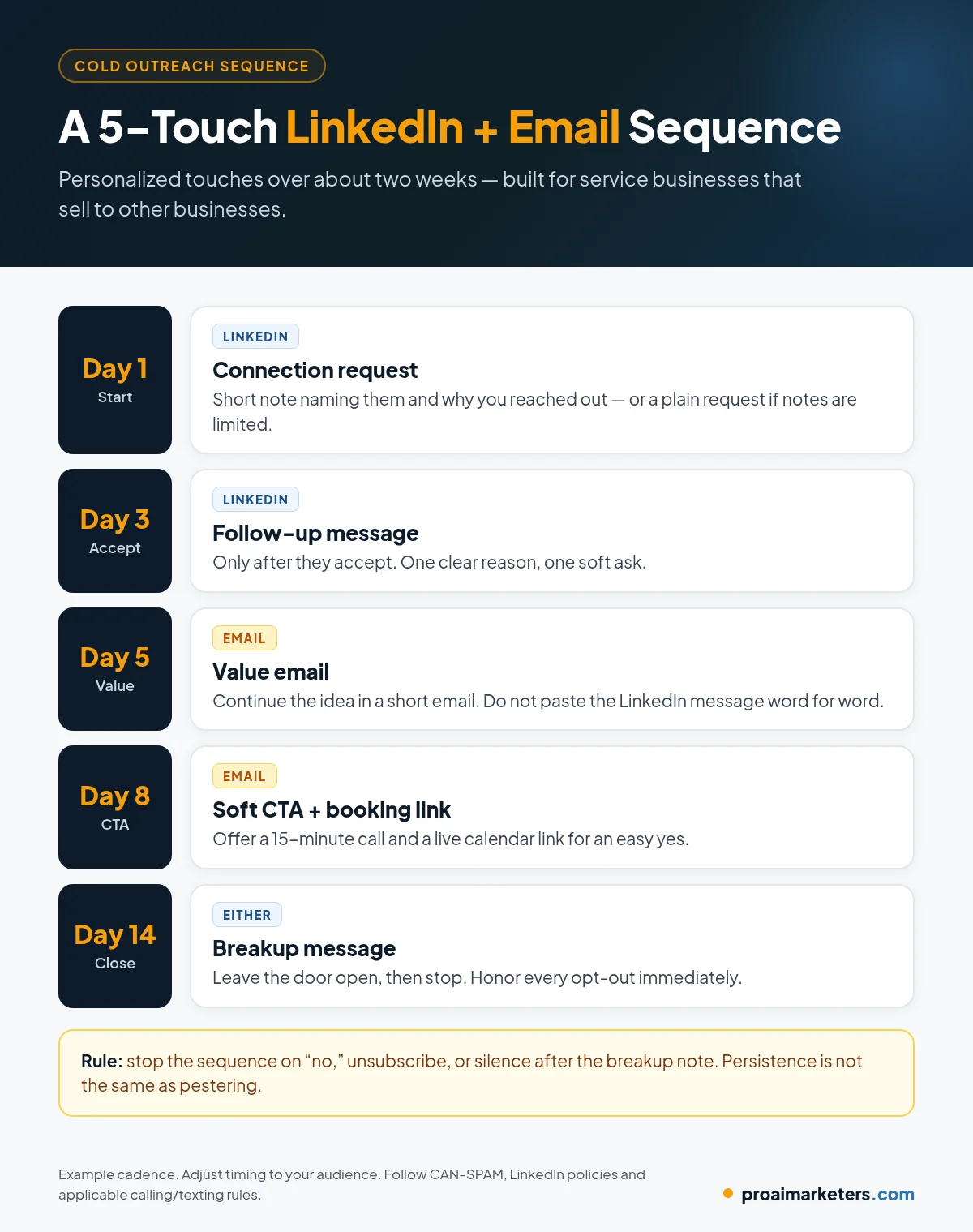
Space touches so you are persistent, not annoying. Stop immediately when someone says no, asks to be removed or never engages after the breakup note.
Step 5: Handle Replies Like Speed-to-Lead Matters
Outreach only pays off if replies get answered fast.
- Route interested replies to a real person the same day.
- Offer two concrete times or a calendar link from your appointment booking system.
- Tag outcomes in the CRM: meeting booked, not now, bad fit, do not contact.
- Move “not now” contacts into a light long-term nurture instead of deleting them or hammering them weekly.
If your inbound leads already wait hours for a response, fix that before you add cold volume. Outreach multiplies conversations; it also multiplies slow follow-up pain.
Compliance and Deliverability Basics (Not Legal Advice)
Cold outreach sits at the intersection of platform rules, email law and phone rules. This is general information, not legal advice:
- Email (U.S.): CAN-SPAM requires accurate headers, a physical postal address and a working unsubscribe for commercial email. Some states have additional rules. Transactional messages and commercial prospecting are treated differently; know which you are sending.
- LinkedIn: Follow LinkedIn’s user agreement and professional community policies. Automated spammy behavior can restrict your account.
- Calling: If you dial prospects, understand Do Not Call and telemarketing rules that may apply to your situation.
- Texting: Do not use cold SMS to consumer numbers as a default outbound channel unless counsel has cleared consent and use case.
- Truthfulness: No fake “quick question” subject lines that hide a pitch unrelated to the body. No fabricated results.
Protect deliverability: authenticate your sending domain (SPF, DKIM, DMARC), warm up new inboxes, keep complaint rates low and remove bounces.
Metrics Worth Watching (Without Vanity)
Track a short weekly scorecard:
- Connection accept rate (LinkedIn)
- Reply rate (by channel)
- Positive reply rate (interested or asked a real question)
- Meetings booked
- Opportunities or jobs created from those meetings
- Unsubscribe / “stop contacting me” rate
Vanity metrics like raw sends do not pay the bills. If replies are high but meetings are low, your offer or ask is unclear. If meetings are fine but closes are not, the issue is sales process, not the sequence.
Cold Outreach vs. Ads vs. Reactivation
Use the right tool for the job:
| Approach | Best for | Relies on |
|---|---|---|
| Cold outreach | Starting new B2B conversations on purpose | List quality + message relevance + reply speed |
| Paid ads | Capturing people already searching or scrolling | Budget + creative + fast lead response |
| Database reactivation | Past leads and customers who already know you | Permission + a real reason to reach out |
Most healthy service businesses eventually use more than one. Cold outreach should not be the excuse to ignore past clients sitting quietly in your CRM.
Common Mistakes to Avoid
- Buying huge cheap lists. You inherit bad data and angry recipients.
- Pitching in the first line. Earn one reply before you ask for a long demo.
- Identical copy to 500 people. Platforms and humans both notice.
- No calendar path. Interested people cool off while you play email tag.
- Ignoring negative replies. Honor opt-outs immediately and update the CRM.
- Running outreach while inbound is broken. Fix response time on people who already contacted you.
Frequently Asked Questions
What is cold outreach for a service business?
It is a structured way to contact potential customers who have not reached out yet, usually through LinkedIn and email, with personalized messages meant to start a conversation and book a meeting.
Is cold email legal?
Commercial email is regulated. In the U.S., CAN-SPAM sets baseline requirements for most commercial messages, and other rules may apply. This guide is not legal advice; get counsel for your situation and follow platform and carrier policies.
How is cold outreach different from spam?
Spam is irrelevant bulk messaging with no real targeting or opt-out care. Serious outreach uses a tight list, personalized relevance, respectful frequency and immediate stops when asked.
How many touches should a sequence include?
Enough to be found, not so many that you become noise. A handful of touches over about two weeks across LinkedIn and email is a common starting pattern; adjust based on your audience and reply data.
Can residential home-service brands use cold outreach?
Sometimes, for partnerships (property managers, realtors, builders) or commercial accounts. Blind consumer email or text blasts are usually the wrong tool; local SEO, ads and referral systems tend to fit better for homeowner demand.
Should I automate everything?
Automate scheduling and logging. Keep personalization and reply handling human enough that a real conversation can happen. Heavy automation without list quality is how accounts get restricted.
Build Conversations on Purpose
Waiting only for referrals and inbound form fills leaves your calendar at the mercy of whoever happens to find you. A careful cold outreach system gives you another dial: who you contact, what you say and how many meetings you set up this month.
At Pro AI Marketers, we build cold outreach systems for service businesses across the U.S., including list building, LinkedIn and email sequences and booking handoff into your CRM.
Book a free strategy call. We’ll define your ideal customer profile and outline a sequence you can run without torching your sender reputation.