
Every call that comes into a service business sounds the same for the first ten seconds. Then you find out. One caller needs an emergency repair today and lives two miles away. Another wants a price for a job you don’t do, in a town you don’t serve. A third is a robocall.
When you or your front desk answer every one of those calls by hand, the good leads wait while the bad ones eat your time. AI receptionist lead qualification fixes that by asking the right questions on every call, sorting callers by fit and urgency, and booking the ones you actually want.
This guide explains how it works, which questions to ask, the features to look for, and how to set it up without annoying callers.
Want it done for you? Our AI receptionist service answers your calls, qualifies each caller with your questions, and books the good ones straight onto your calendar.
What Is AI Receptionist Lead Qualification?
AI receptionist lead qualification is when an AI phone agent answers your calls, asks a short set of screening questions you choose, and uses the answers to decide the next step: book the appointment, transfer to a person, send information, or politely decline. It turns a ringing phone into a sorted list of real opportunities.
Lead capture vs. lead qualification
These two get mixed up, so here’s the difference:
- Lead capture records who called and why: name, phone number, and a short note.
- Lead qualification goes further. It checks whether the caller is a fit for your business (right service, right area, right timing) and how urgent the need is, so the right thing happens next.
A basic answering service captures. A well-configured AI receptionist does both, and it does it the same way on the first call of the day and the last one at 11 p.m.
Why Does Lead Qualification Matter for Small Service Businesses?
Owners of small service businesses rarely have a sales team. The person who answers the phone is often the same person doing the work. That creates a few predictable problems:
- Good leads wait. While you’re on a long call with a price shopper, a ready-to-book caller goes to voicemail and calls someone else.
- Bad-fit calls eat hours. Out-of-area requests, services you don’t offer, and spam calls all take time to sort out by hand.
- Questions get skipped. On a busy day, nobody remembers to ask for the address, the timeline or how the caller heard about you.
- After-hours calls go nowhere. Plenty of people call in the evening or on weekends, when no one is there to answer.
Qualifying every caller the same way solves all four. It also makes your follow-up faster, and fast follow-up matters: in a study published in Harvard Business Review, firms that tried to contact web leads within an hour were nearly seven times as likely to qualify them as firms that waited even an hour longer (HBR, “The Short Life of Online Sales Leads”). An AI receptionist doesn’t wait at all.
How Does an AI Receptionist Qualify a Lead, Step by Step?
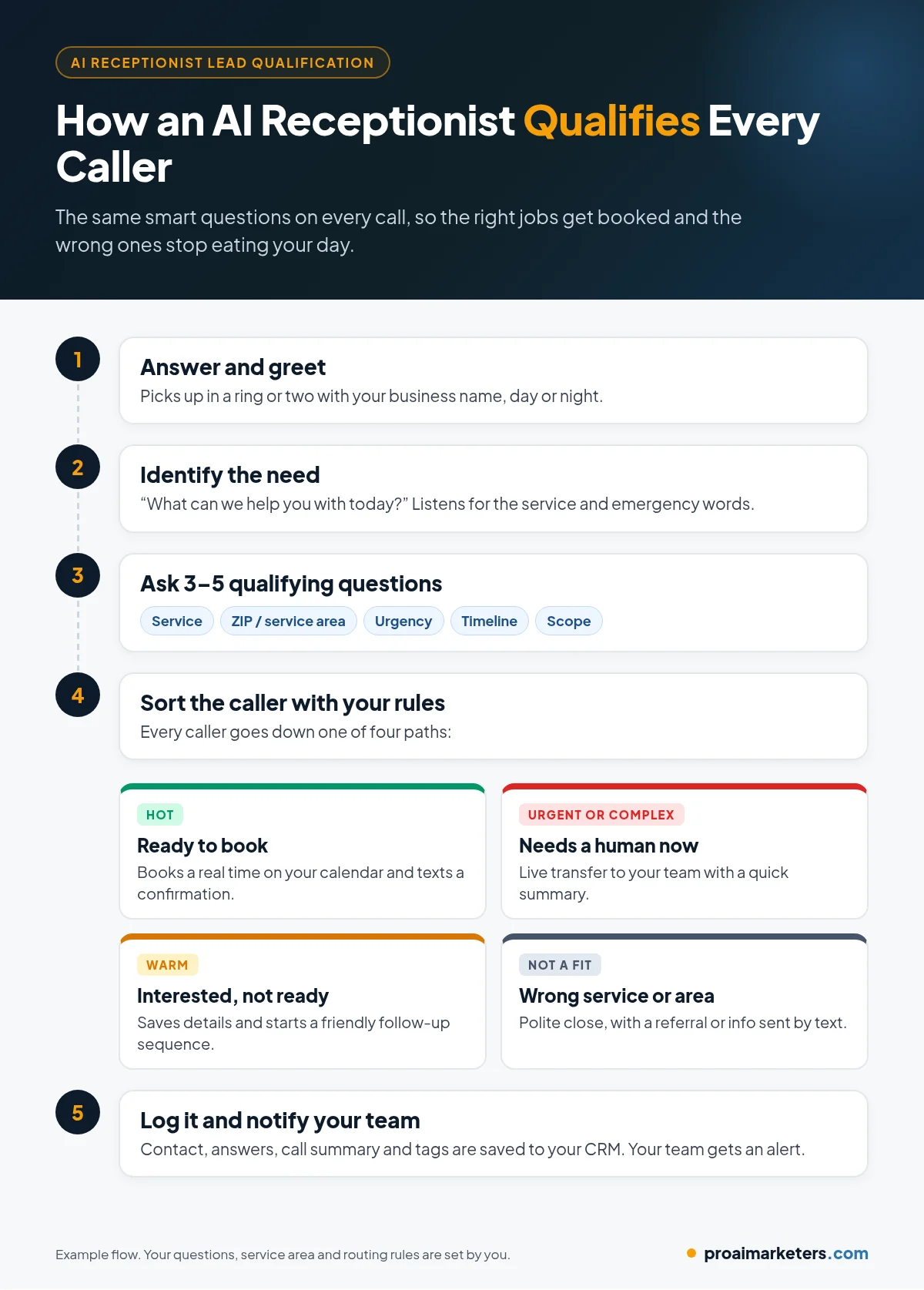
Here’s the typical flow on an inbound call:
- Answer and greet. The AI answers within a ring or two, using your business name and a friendly script.
- Identify the need. “What can we help you with today?” The AI listens for the service, the problem and any emergency words.
- Ask your qualifying questions. Usually three to five: what service, where the job is, how soon, and anything else that decides fit for your business.
- Decide the next step. Based on your rules, the caller is sorted into a path: ready to book, interested but not ready, not a fit, or needs a human now.
- Take the action. Book a time on your calendar, transfer the call live, send a text with information, or close the call politely with a referral.
- Log everything. The contact, answers, a call summary and a tag go into your CRM, and your team gets a notification.
What Questions Should an AI Receptionist Ask to Qualify Leads?
Keep it short. Every extra question is a chance for the caller to get impatient. Pick the few answers that actually change what you do next.
| Question type | Example wording | Why it matters |
|---|---|---|
| Service needed | “What can we help you with today?” | Confirms you offer it and routes to the right person |
| Location | “What’s the ZIP code where you need the service?” | Screens out jobs outside your service area |
| Urgency | “Is this an emergency, or can it wait a few days?” | Decides between a live transfer and a booked slot |
| Timeline | “When are you hoping to get this done?” | Separates ready-now buyers from future projects |
| Scope or budget fit | “Is this a repair or a full replacement?” | Matches the job to your services and pricing |
| Decision maker | “Will anyone else be part of the decision?” | Helps you book the right people for estimates |
Example question sets by industry
- HVAC, plumbing and electrical: the problem, the ZIP code, whether there’s an active leak or no heat or cooling, and whether the caller owns or rents.
- Cleaning services: the type of clean (regular, deep, move-out, rental turnover), the property size, the ZIP code and the date needed.
- Med spas and beauty studios: the treatment of interest, whether they’re a new or returning client, and their preferred days and times.
- Professional services such as notaries or legal intake: the type of document or matter, the location, the deadline and the best way to follow up.
What Lead Qualification Features Should an AI Virtual Receptionist Have?
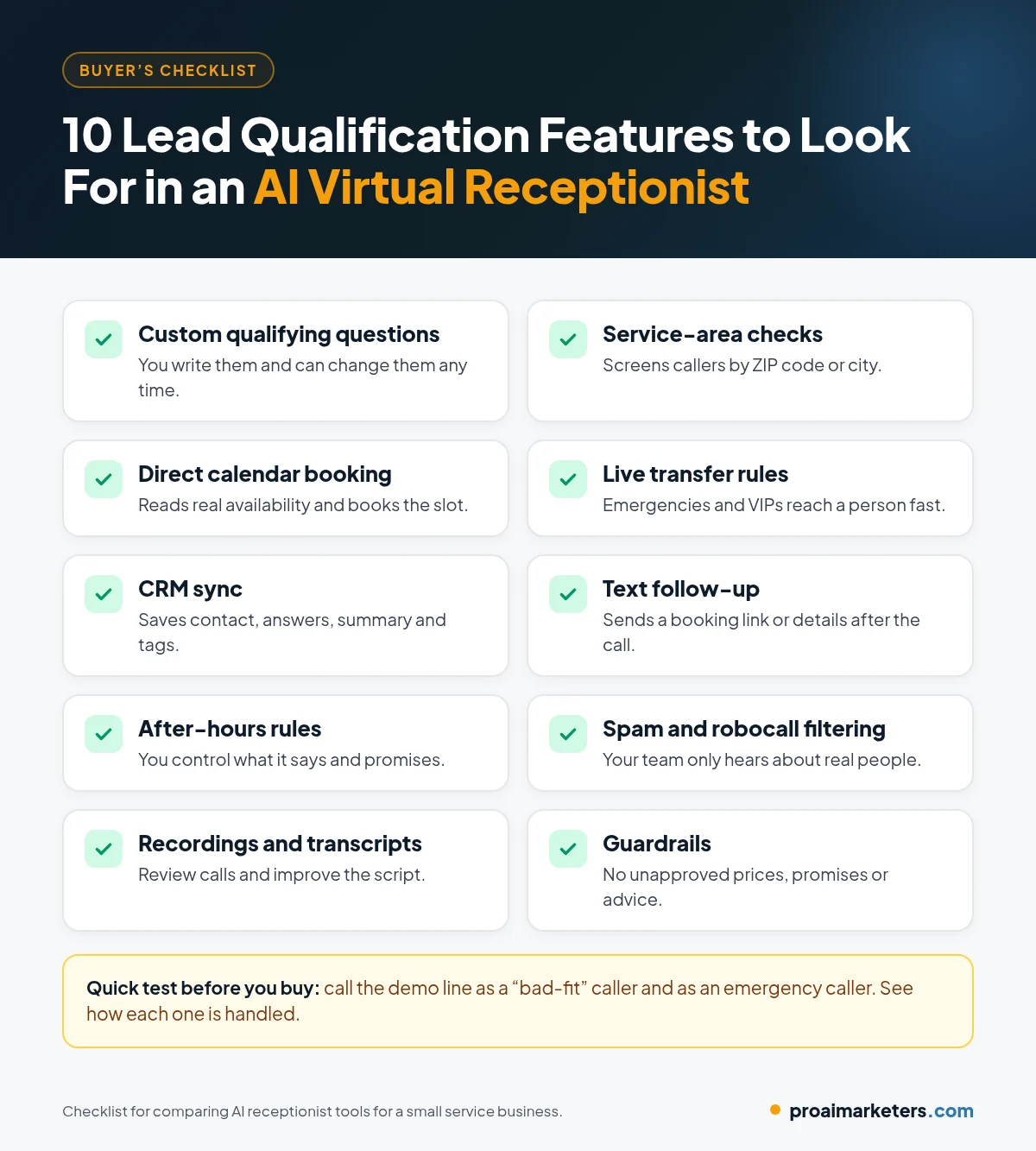
Not every AI receptionist can qualify leads well. When you compare AI virtual receptionist lead qualification features, look for these:
- Custom qualifying questions that you write and can change any time.
- Service-area checks by ZIP code or city, so out-of-area callers get a polite answer instead of an appointment.
- Calendar booking that reads your real availability and books directly.
- Live transfer rules for emergencies, VIP customers or anything the AI shouldn’t handle.
- CRM sync that saves the contact, answers, call summary and tags automatically.
- Text follow-up that sends a booking link or details after the call.
- After-hours behavior you control, including what to promise and when your team will respond.
- Spam and robocall filtering so your team only hears about real people.
- Recordings, transcripts and summaries so you can review calls and improve the script.
- Guardrails that stop the AI from quoting prices, promising times or giving advice you haven’t approved.
How Should You Set Up Scoring and Routing Rules?
You don’t need a complicated point system. Most small businesses do fine with four simple paths:
- Hot: right service, in your area, needs it soon. Book it now, or transfer live if it’s urgent.
- Warm: a good fit but not ready, such as a project next season. Capture the details and add them to a follow-up sequence.
- Not a fit: a service you don’t offer or outside your area. Thank them, and refer them elsewhere if you can.
- Needs a human: complaints, complex quotes, existing customers with a problem, or anyone who asks for a person.
Write these rules down in plain language before you configure anything. If your team can’t agree on what a “hot” lead is, the AI won’t be able to either.
Is an AI Receptionist Right for Your Small Business?
An AI receptionist for small business is usually a good fit if:
- You or your team regularly miss calls because you’re on jobs or with clients.
- A meaningful share of your calls are bad fits, spam or simple questions.
- You get calls after hours or on weekends.
- Your jobs can be booked into a calendar with clear rules.
It may not be the right first step if you get very few calls, if every job needs a long custom conversation before booking, or if nobody is available to handle transfers and follow-up. In that case, start with missed call text back, which sends an automatic text to anyone you couldn’t answer.
What Mistakes Should You Avoid?
- Asking too many questions. Three to five is plenty. Collect the rest at the appointment.
- Sounding like a phone tree. Write the script the way your best team member talks.
- No escape hatch. Callers who ask for a person should be able to reach one or get a fast callback.
- Letting the AI guess. If it doesn’t know a price or policy, it should say someone will follow up.
- Never reviewing calls. Listen to a sample of recordings every week and tighten the script.
- Disconnected tools. If qualified leads don’t land in your CRM and calendar, someone still has to do the work by hand.
What About Compliance and Caller Trust?
This is general information, not legal advice. A few points to check with your provider and an attorney:
- Call recording consent rules vary by state, and some states require every party’s consent. Tell callers when calls are recorded.
- Be honest that it’s AI when asked, and follow any disclosure rules that apply where you do business.
- Outbound calls are different. The FCC has ruled that AI-generated voices count as “artificial” under the Telephone Consumer Protection Act, so outbound AI calls follow the same consent rules (FCC announcement).
- Follow-up texts need proper business texting registration and a clear way to opt out.
How Does AI Lead Qualification Fit Into Your Whole Follow-Up System?
An AI receptionist works best as one part of a connected setup:
- A CRM stores every caller, answer and recording in one place.
- An omni-channel AI responder applies the same qualifying questions to texts, web chat and social messages.
- Warm leads that never booked can be revisited later with a database reactivation campaign.
- If you want to see where else automation can save time, read how small businesses can save 20 hours per week with automation.
Related guides: speed to lead and automated appointment booking and AI reputation management.
Frequently Asked Questions
What is AI receptionist lead qualification?
AI receptionist lead qualification is when an AI phone agent answers calls, asks a few screening questions you choose, and uses the answers to book, transfer, follow up with, or politely decline each caller.
What questions should an AI receptionist ask to qualify leads?
Most service businesses only need three to five questions: what service the caller needs, where the job is, how urgent it is, and when they want it done. Add a scope or budget question only if it changes what you do next.
Can an AI receptionist book appointments directly?
Yes, if it is connected to your calendar. A good setup checks your real availability, books the time, and sends the caller a confirmation by text or email.
Will callers know they are talking to an AI?
Many callers can tell, and you should be honest if they ask. A natural script, quick answers and an easy way to reach a person matter more to most callers than whether the voice is human.
Is an AI receptionist worth it for a small business?
It is usually worth it if you miss calls while working, get many bad-fit or spam calls, or receive calls after hours. If you get very few calls, missed call text back is a simpler place to start.
Stop Spending Your Day on the Wrong Calls
Lead qualification is really about protecting your time. When every caller is asked the same smart questions, the right jobs get booked fast and the wrong ones stop interrupting your day.
At Pro AI Marketers, we set up AI receptionists for local service businesses across the U.S., with your questions, your service area and your calendar built in. You can also explore all of our services.
Book a free strategy call. We’ll review how calls reach your business today and map out a qualification script that fits how you work.