How AI Agents Will Redefine Work, Productivity, and Business in 2026
4–5 minute read
For years, artificial intelligence was treated as a support tool — something that helped humans work a little faster. That era is ending.
According to enterprise AI adoption forecasts, 2026 will be the year AI agents stop assisting work and start actively running it. These agents are no longer limited to answering questions or generating text. They can now interpret objectives, design action plans, collaborate with other agents, and execute tasks with minimal human input.
The result? A fundamental shift in how businesses operate, how employees work, and how value is created.
Below are five major transformations AI agents are expected to bring in 2026 — not as a distant future, but as an operational reality.
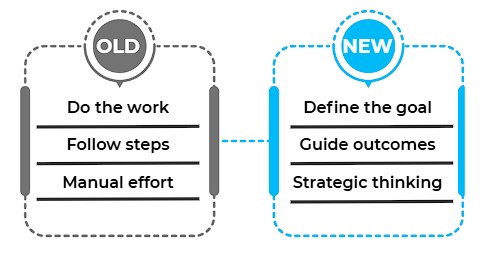
1. Work Will Shift From Execution to Direction
In traditional workflows, employees spend much of their day performing tasks manually — gathering data, preparing reports, responding to emails, and updating systems.
AI agents change this dynamic.
According to workplace automation studies, organizations adopting AI agents are seeing employees transition from task-doers to task-directors. Instead of executing every step, workers define goals and let AI agents handle the process.
AI agents can:
Break down objectives into steps
Decide which tools or systems to use
Complete tasks in the background
Report results for human review
This shift allows employees to focus on judgment, creativity, and decision-making, rather than repetitive work.
Role Evolution
2. Businesses Will Operate on Agent-Driven Systems
AI agents are becoming infrastructure, not features.
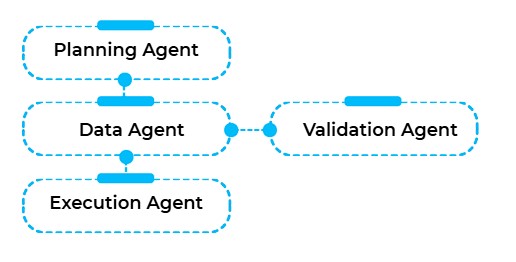
Instead of isolated AI tools, companies are building networks of agents that coordinate with each other across departments — finance, operations, marketing, customer support, and IT.
According to cloud and enterprise software research, agent-based systems can:
Run multi-step workflows end to end
Reduce handoffs between teams
Eliminate delays caused by manual approvals
In 2026, it will be common for businesses to design workflows where multiple AI agents communicate, negotiate, and act together, with humans supervising only when necessary.
Agent Network
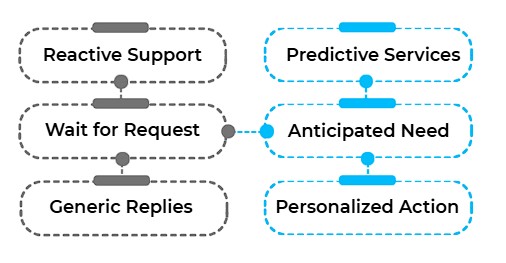
3. Customer Experience Will Become Predictive, Not Reactive
Customer service is undergoing a quiet transformation.
Instead of waiting for customers to reach out, AI agents are increasingly anticipating needs and resolving issues before frustration occurs.
According to customer experience benchmarks, organizations using AI agents for transactional workflows have:
Automated the majority of routine interactions
Reduced response times from hours to minutes
Improved consistency across channels
AI agents can analyze behavior, history, and intent in real time — enabling personalized, concierge-style interactions at scale.
In 2026, customers will expect:
Immediate responses
Context-aware conversations
Seamless handoffs between AI and humans
Customer Experience Transformation
4. Security Teams Will Gain AI Teammates
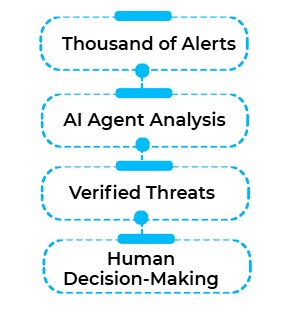
Modern security operations generate more alerts than humans can realistically process.
AI agents are stepping in as digital security analysts, capable of monitoring systems continuously and responding faster than manual teams ever could.
According to financial and cybersecurity performance reports, AI-driven security agents help organizations:
Filter noise from real threats
Reduce false alerts significantly
Improve fraud detection accuracy
By 2026, AI agents are expected to handle:
Alert triage
Initial investigations
Pattern recognition across massive datasets
This allows human experts to focus on high-risk threats and strategic defense planning.
Security Workflow
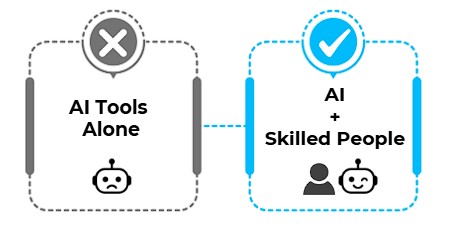
5. The Most Valuable Skill Will Be Knowing How to Work With AI
Buying AI tools is easy. Using them well is not.
According to workforce development research, companies that fail to train their people struggle to realize AI’s full value. As a result, 2026 will see a shift toward building AI-literate teams, not just deploying technology.
Organizations will invest in:
Continuous AI learning programs
Real-world, role-specific training
Practical experience supervising AI agents
Employees won’t need to become engineers — but they will need to understand how to guide, evaluate, and collaborate with AI systems.