The Real Role of AI: Empowering People
The panic button has been pressed. Across boardrooms and break rooms alike, the same fear echoes: Will AI take my job? What if AI isn’t your competition? What if it’s your secret weapon?
Welcome to the age of human-AI augmentation, where technology multiplies your capabilities. Think of it as getting a turbo boost in a video game, except this power-up is real, available right now, and it’s transforming how the world’s top performers work.
The Reality Check: AI is Already Here (And It’s Not What You Think)
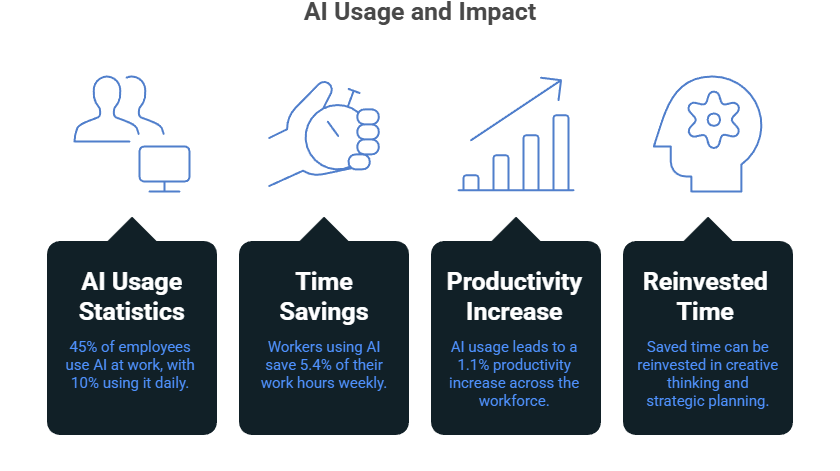
Let’s cut through the noise with some hard facts. According to recent workplace studies, 45% of employees now use AI at work at least a few times a year, with daily use climbing to 10% of the American workforce. But here’s where it gets interesting: workers using AI report saving 5.4% of their work hours in a typical week, translating to a 1.1% productivity increase across the entire workforce.
That might sound modest until you realize we’re talking about getting back nearly three hours every single week—time you can reinvest in creative thinking, strategic planning, or finally tackling that project you’ve been putting off.
The Million-Dollar Question: Will AI Replace Me?
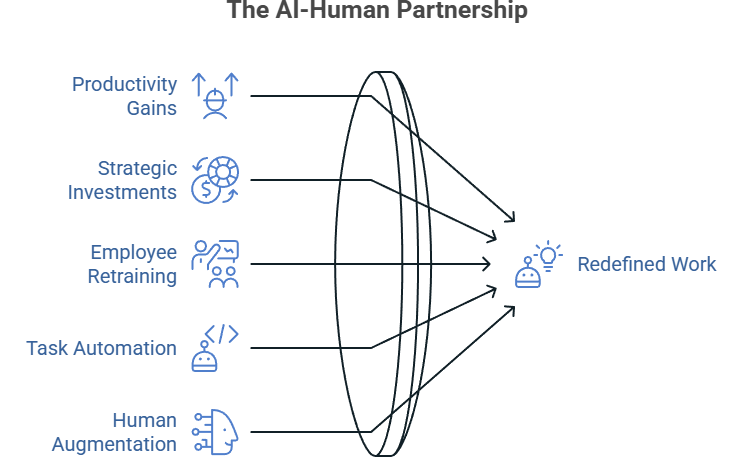
This is the elephant in every Zoom room. Let me hit you with some reassuring truth: 96% of organizations investing in AI are experiencing productivity gains, with 57% reporting significant improvements. And what are they doing with these gains?
Surprise—they’re not slashing headcount. Companies are channeling productivity gains from AI into existing and new AI capabilities, research and development, cybersecurity, and retraining employees rather than reducing headcount.
The real shift isn’t about humans versus machines. It’s about redefining what “work” means. Research shows that AI automation works best for repetitive and well-structured tasks, whereas augmentation is more appropriate for complex tasks.
Translation? AI handles the boring stuff so you can focus on work that requires uniquely human capabilities.
How Top Performers Are Using AI to Become Unstoppable
Forget theory—let’s talk real-world impact. Employees using AI report an average productivity boost of 40%, driven by familiarity with tools, experimentation, and upskilling. But that’s just the beginning.
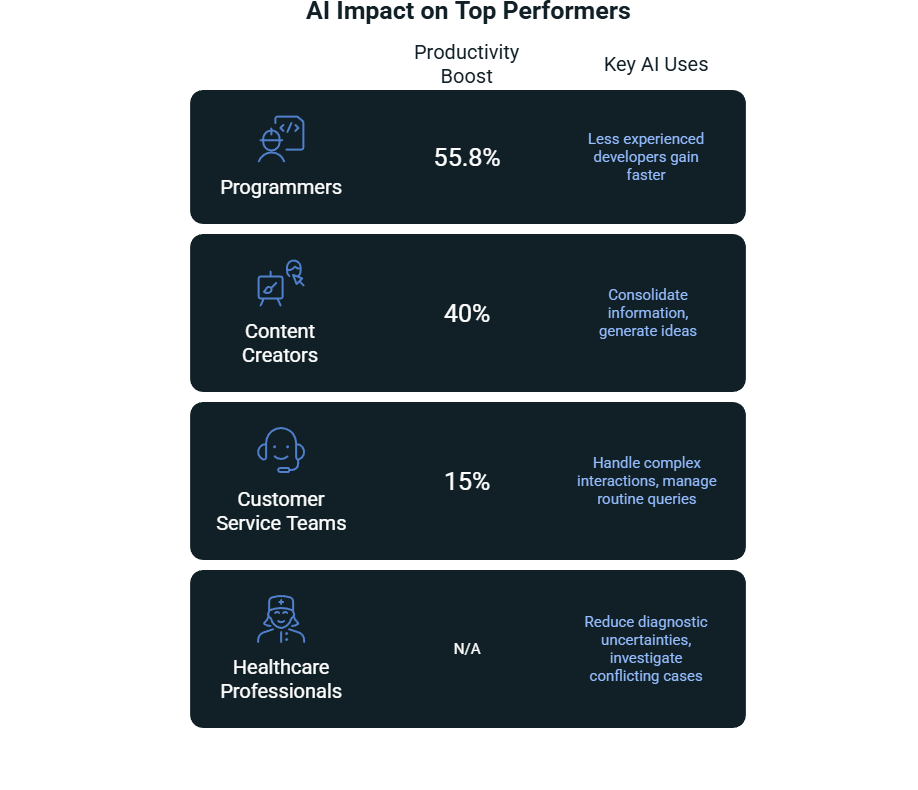
For Programmers: Productivity increases of 55.8% have been documented, with less experienced developers seeing the greatest gains. Junior developers are leveling up faster than ever before.
For Content Creators: 42% of employees use AI to consolidate information and 41% use it to generate ideas, transforming hours of research into minutes.
For Customer Service Teams: AI assistants are delivering 15% productivity improvements, allowing agents to handle more complex, human-centric interactions while AI manages the routine queries.
For Healthcare Professionals: AI systems reduce uncertainties in diagnostic processes by scanning, analyzing, and interpreting patient radiology images, allowing specialists to investigate conflicting cases more effectively.
How Do I Actually Start Using AI Without
Q: “How Do I Actually Start Using AI Without Getting Overwhelmed?”
A: Start small. Don’t try to overhaul your entire workflow overnight. Research shows the most successful implementations happen when people identify one specific pain point—a repetitive task, a time-consuming process—and apply AI to that first. Think email management, meeting summaries, or data analysis.
The key? Workers who use AI frequently are more likely to use specialized tools, suggesting that early experimentation builds confidence for more advanced applications.
Q: “Will Learning AI Skills Actually Benefit My Career?”
A: Absolutely. The World Economic Forum predicts new technologies will disrupt 85 million jobs globally between 2020 and 2025—and create 97 million new job roles. The winners in this shift? Those who can work with AI, not against it.
Think of it this way: when computers first entered offices, the people who thrived weren’t those who rejected technology—they were the ones who learned to leverage it. History is repeating itself, just faster.
Q: “What About the Downsides? Is It All Sunshine and Rainbows?”
A: Real talk- there are challenges. 47% of AI users are unclear on how to achieve expected productivity gains. Additionally, 39% of workers spend more time reviewing AI-generated content, adding to workloads.
The solution isn’t to abandon AI—it’s to use it smarter. Set clear expectations, establish review processes, and remember that AI is a tool, not a replacement for human judgment.
Q: “How Can I Ensure I’m Not Becoming Too Dependent on AI?”
A: This is a smart question. Engineers at leading tech companies report shifting toward higher-level work managing AI systems while experiencing significant productivity gains, though some express concern about long-term career implications.
The key is maintaining your core expertise while using AI to enhance it. Use AI to handle the grunt work, but stay engaged with the strategic thinking, decision-making, and creative problem-solving that defines your field. Think of AI as a calculator for cognitive tasks—it handles the computation, but you still need to understand the math.
The Bottom Line: AI won’t replace you—but someone using AI might. The future belongs to those who see AI not as a threat, but as the ultimate productivity partner. Don’t fight the wave. Learn to surf it.
What’s the first task you’re going to augment with AI today? Drop a comment below and let’s build our unstoppable futures together.